


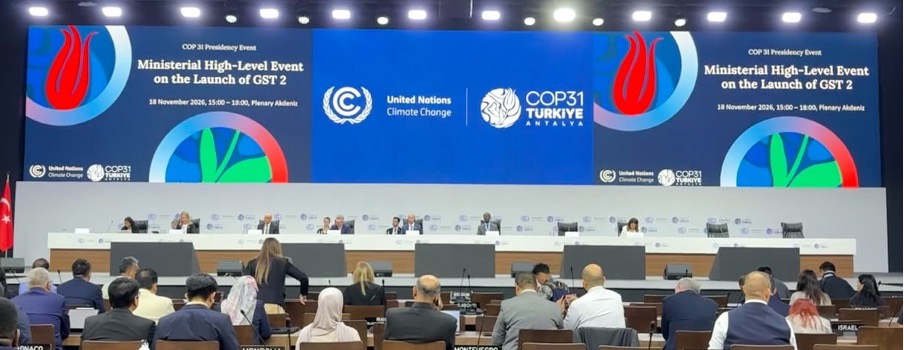
COP31: THE SECOND GLOBAL STOCKTAKE GETS UNDERWAY
The Second Global Stocktake (GST2) of the Paris Agreement has officially launched. Concluding at COP33 in 2028, it will guide the next round of national climate plans (NDCs) due in 2030. Its first phase—information collection—is already decisive: everything fed into the process, from reports by Parties to inputs from observers and technical bodies, will shape the final outcomes. GST2 brings both opportunities and unresolved challenges: on one hand, new tools to assess adaptation and a richer dataset; on the other, uncertainty over the timeline of the technical phase and IPCC reports, alongside the risk of a renewed clash over how to follow up on its results.
In Antalya, the Second Global Stocktake of the Paris Agreement (GST2) has officially kicked off and will conclude at COP33 in 2028. Established under Article 14, the Global Stocktake serves to periodically take stock of collective progress towards the Agreement’s long-term goals—spanning mitigation, adaptation, and means of implementation—by identifying gaps, lessons learned, and best practices. In other words, every five years the international community pauses to assess how far the world has come and how much ground remains to be covered. The first cycle concluded in 2023 at COP28 in Dubai.
How Does the Global Stocktake Work?
The process begins every five years, lasts two years, and is synchronised with national climate plans—Nationally Determined Contributions (NDCs)—concluding roughly two years ahead of the deadline for submitting new NDCs so as to inform them (Paris Agreement, Articles 4.9 and 14.3).
As illustrated in the diagram below, the Global Stocktake is structured into three successive, partially overlapping phases (Decision 19/CMA.1, para. 3):
- Information Collection and Preparation (ICP): gathering, compiling, and synthesising data from a wide range of input sources;
- Technical Assessment (TA): technical dialogues to analyse the synthesised information and measure collective progress;
- Consideration of Outputs (CoO): the final, political phase aimed at identifying opportunities, challenges, measures, and best practices to strengthen climate action and support. It concludes with a formal decision capturing political messages and recommendations (for the first GST, this was Decision 1/CMA.5, adopted at COP28).
For GST2, following the launch of the first phase at COP31, the Technical Assessment will begin in June 2027, and the political phase will conclude at COP33 in 2028.
Why Does the First Phase Matter?
COP31 marks the start of the first phase of GST2, dedicated to information collection. While it may look like a preparatory, almost bureaucratic step, it shapes everything that follows: the data entering the process now will determine the outcomes emerging in 2028. Input sources are diverse and include national reports from Parties, contributions from UNFCCC constituted bodies, the Secretariat, civil society, UN agencies, and other international organisations. Voluntary submissions—open to observers as well—must be submitted by 28 February 2027 and will feed directly into the Technical Assessment. Everything negotiated today at COP31, from adaptation to the just transition, will help define what goes into GST2.
Opportunities and Risks of the Second Global Stocktake
GST2 takes place in a markedly different landscape from the first cycle: exceeding the 1.5°C threshold is now widely considered inevitable, and the Glasgow deadline to double adaptation finance by 2025 has already passed. On the positive side, the process will draw on a substantially richer evidence base thanks to the new national climate plans (NDCs 3.0) and the Biennial Transparency Reports (BTRs), through which every country reports every two years on its emissions, NDC implementation, and support provided or received.
Following the first cycle, several Parties raised concerns—including the compression between the technical and political phases, insufficient time to negotiate the final decision, the need to integrate loss and damage, and poor alignment with the publication schedule of IPCC reports. Decision 3/CMA.7 (paras. 15–21), adopted in Belém, addressed several of these shortcomings.
To give the political phase more breathing room, the new indicative timeline provides for two technical dialogues in 2027 instead of the three held during the first stocktake, while leaving open the option of a third. However, this compromise reduces the time available to examine an even larger body of material, creating the risk that submissions arrive after the dialogues have already closed. Added to this is uncertainty surrounding the IPCC’s Seventh Assessment Report (AR7): after the Addis Ababa plenary was suspended, closing for the sixth consecutive time without agreement on a timeline, the three Working Group reports risk missing the deadline, potentially forcing GST2 to rely once again on the 2023 AR6.
There is also the danger that science once again gets lost in politics. As noted by the International Institute for Sustainable Development (IISD), during the first cycle a substantial share of the technical evidence—including best practices on adaptation—was left out of the final decision. Without an explicit link between the technical and political phases, GST2 risks falling back on generic language that does little to ratchet up ambition.
On adaptation, however, GST2 offers the opportunity for a far more structured assessment than the first cycle, which lacked a common yardstick. Today, Parties have the global resilience framework adopted in Dubai (the UAE Framework for Global Climate Resilience), the 59 indicators approved in Belém (the Belém Adaptation Indicators)—still awaiting operationalisation—and fresh financial data from UNEP’s Adaptation Gap Report.
Yet one central sticking point remains: how to follow up on the outcomes of the stocktake? Between Dubai and Belém, far more time was spent debating how to track the implementation of GST1 than on implementation itself. The dialogue established for this purpose (the United Arab Emirates Dialogue) had been placed under the finance section of the Dubai decision (1/CMA.5, para. 97): for some Parties, this meant reviewing only the financial support pledged by developed countries, while for others it covered all stocktake outcomes. After two years of deadlock, Belém defined its modalities, establishing reports that will feed into GST2 (Decision 3/CMA.7, para. 9), yet without resolving the clash between the two interpretations: the dialogue remains a space for exchange rather than accountability. With adaptation increasingly tied to means of implementation, the very same dispute risks flaring up again in 2028.
The Second Global Stocktake will not be decided solely at COP33 in 2028—it is already being shaped today by what enters the process and by the negotiations defining its scope. With hard-won achievements from the first cycle far from consolidated—starting with the commitment to transition away from fossil fuels—the core question for the next two years is clear: what do we want GST2 to say, and how do we ensure it does not remain merely on paper?
Article by Elisa Mauri, Italian Climate Network delegate at COP31 in Antalya.
Cover image: photo by Elisa Mauri